
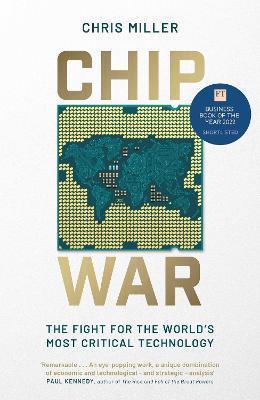
Chip War: The Fight for the World’s Most Critical Technology
Candle Safety
1. Trim your wick before burning your candle the first time and every subsequent burn thereafter.
2. We advise burning your candle for periods of no longer than three hours at a time.
3. Discontinue burning your candle when there is 10mm / 1cm of wax is remaining.
4. Always burn your candle on a stable and heat resistant surface, away from drafts or items that can catch alight.
5. Never leave a burning candle unattended, near children or pets.
6. If you’re burning more than one candle at a time, space your candles approximately 100mm (10cm) apart.
Description ***Winner of the Financial Times Business Book of the Year award*** ‘Pulse quickening. A nonfiction thriller – equal parts The China Syndrome and Mission Impossible’ New York Times An epic account of the decades-long battle to control the world’s most critical resource-microchip technology Power in the modern world – military, economic, geopolitical – is built on a foundation of computer chips. America has maintained its lead as a superpower because it has dominated advances in computer chips and all the technology that chips have enabled. (Virtually everything runs on chips: cars, phones, the stock market, even the electric grid.) Now that edge is in danger of slipping, undermined by the naive assumption that globalising the chip industry and letting players in Taiwan, Korea and Europe take over manufacturing serves America’s interests. Currently, as Chip War reveals, China, which spends more on chips than any other product, is pouring billions into a chip-building Manhattan Project to catch up to the US. In Chip War economic historian Chris Miller recounts the fascinating sequence of events that led to the United States perfecting chip design, and how faster chips helped defeat the Soviet Union (by rendering the Russians’ arsenal of precision-guided weapons obsolete). The battle to control this industry will shape our future. China spends more money importing chips than buying oil, and they are China’s greatest external vulnerability as they are fundamentally reliant on foreign chips. But with 37 per cent of the global supply of chips being made in Taiwan, within easy range of Chinese missiles, the West’s fear is that a solution may be close at hand. ‘A riveting history. Features vivid accounts and colourful characters’ Financial Times ‘Fascinating…A historian by training, Miller walks the reader through decades of semiconductor history – a subject that comes to life thanks to [his] use of colorful anecdotes’ Forbes ‘Indispensable’ Niall Ferguson